
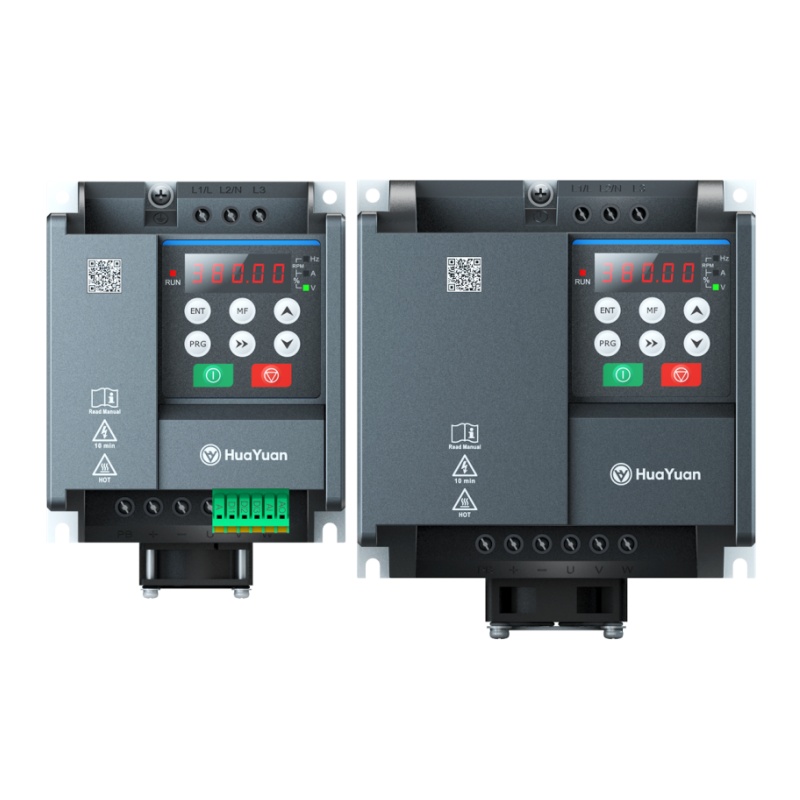
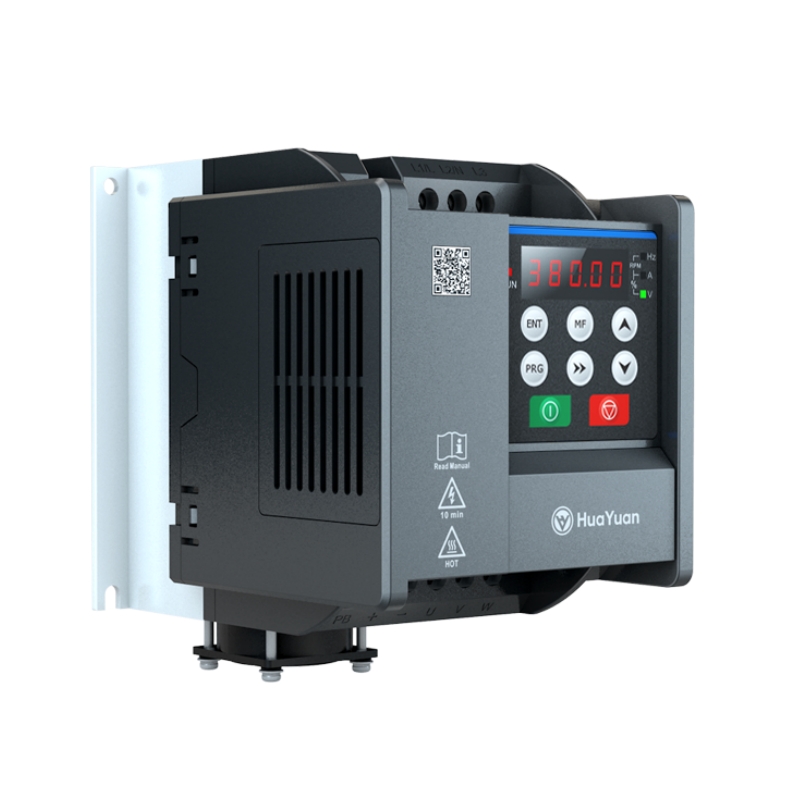
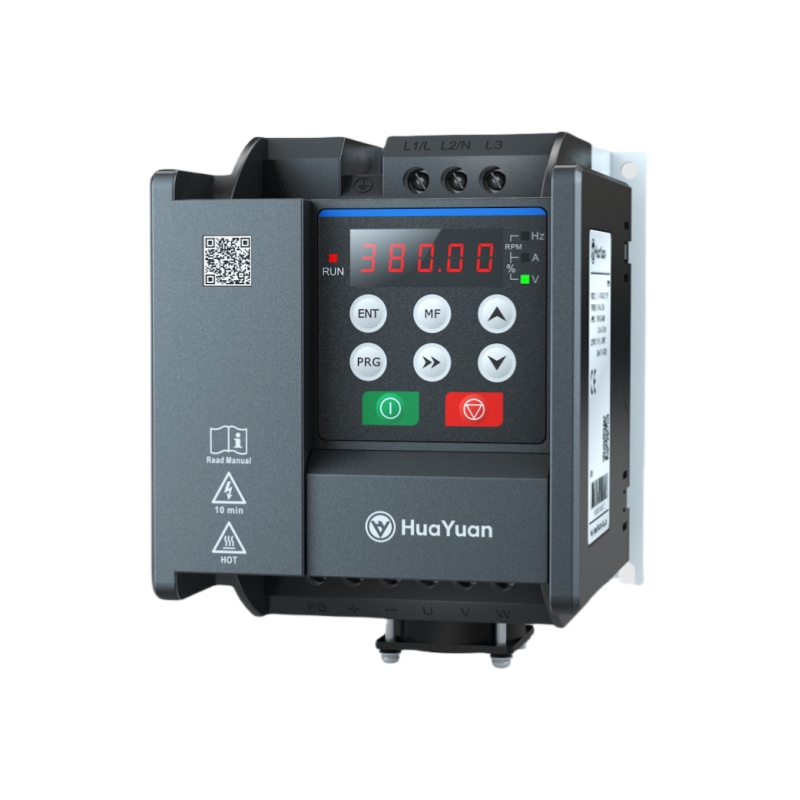
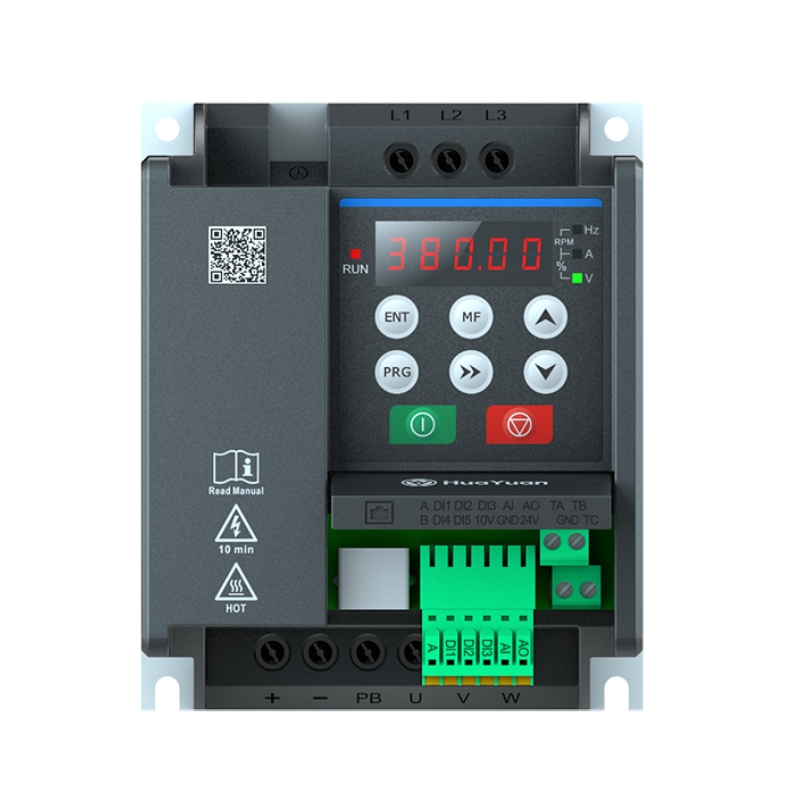
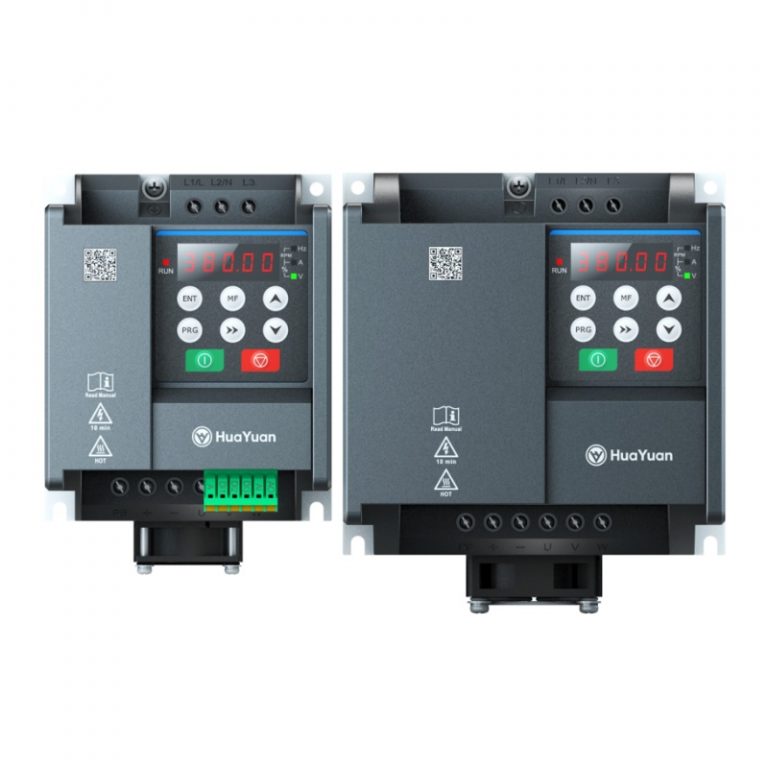
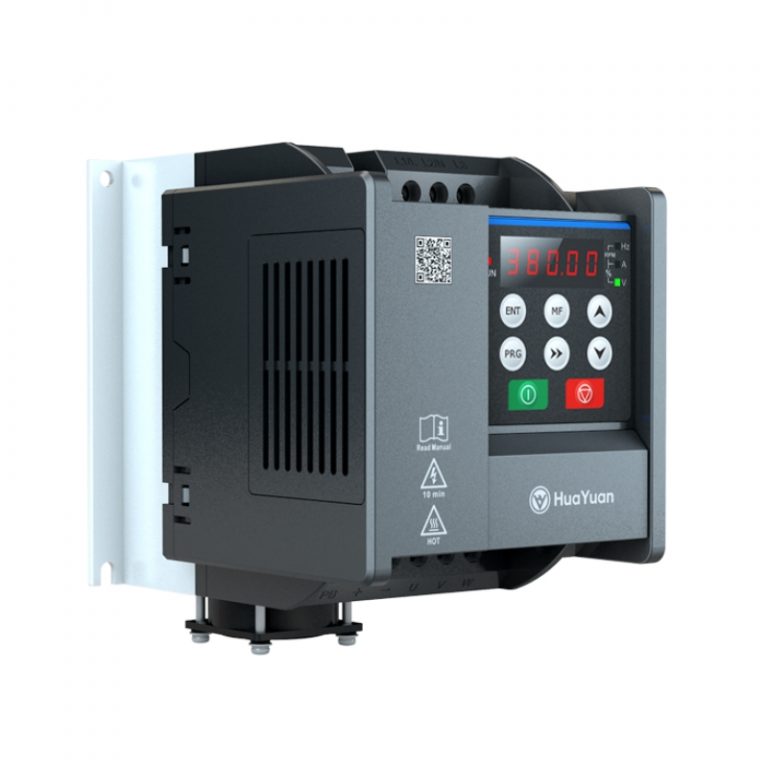
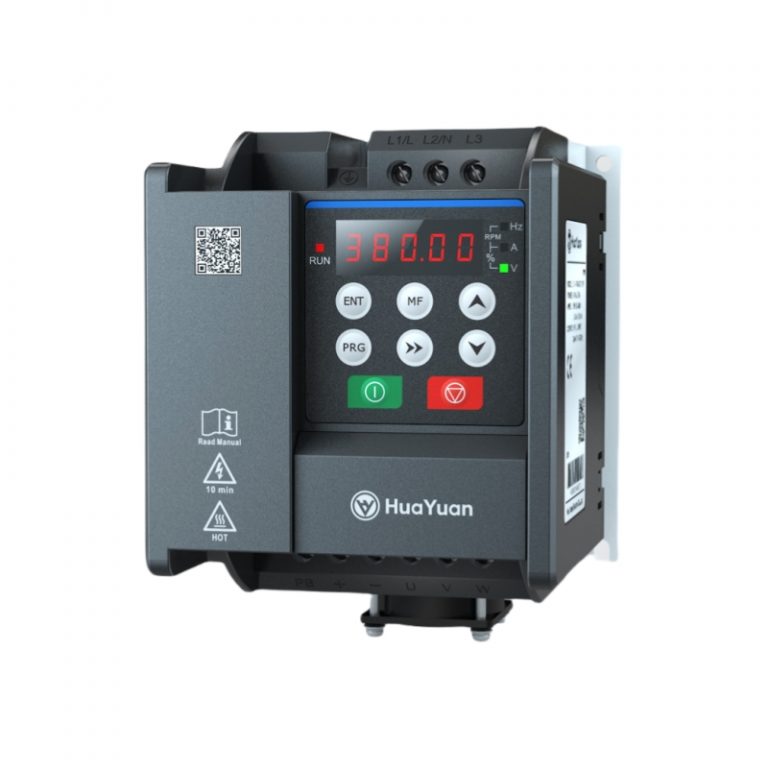
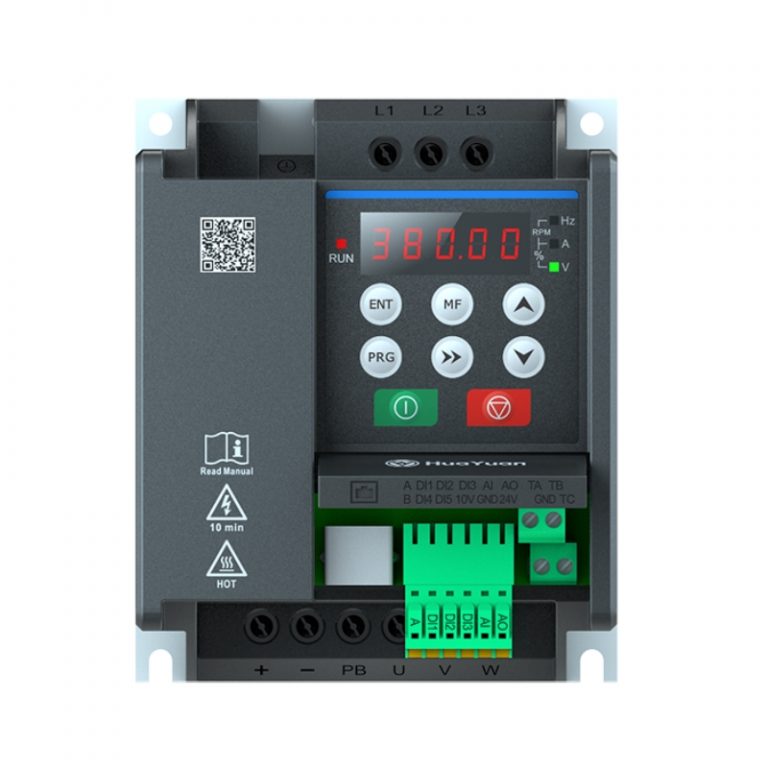
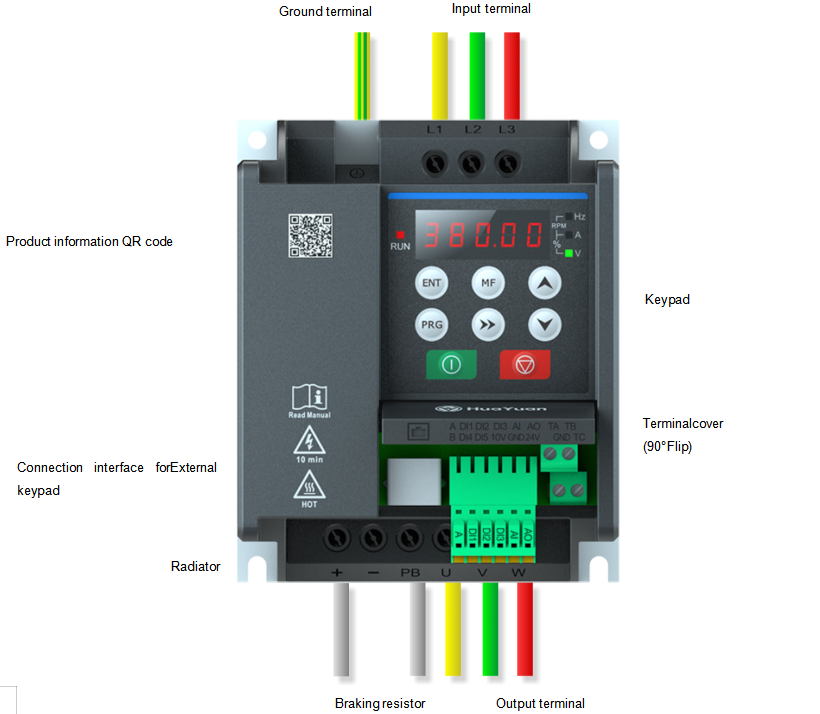
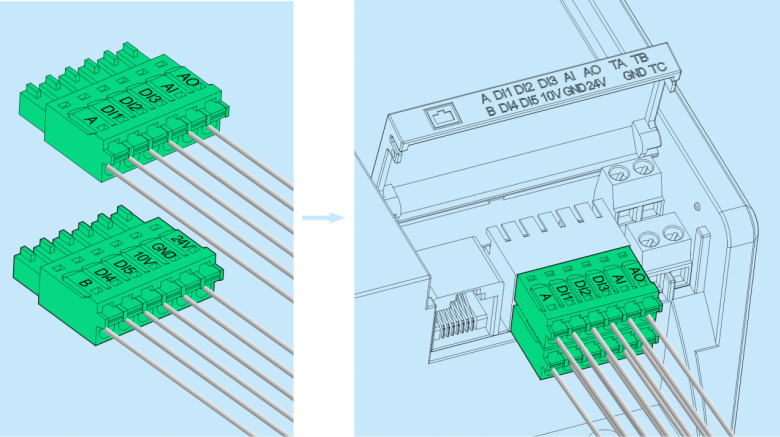
Connect the wires according to the symbols on the corresponding terminals, open the wiring cover on the front of the product, and then insert the connected terminals into the terminal base according to the terminal symbols on the wiring cover. This function is easy to wire, simple to operate, and not prone to errors
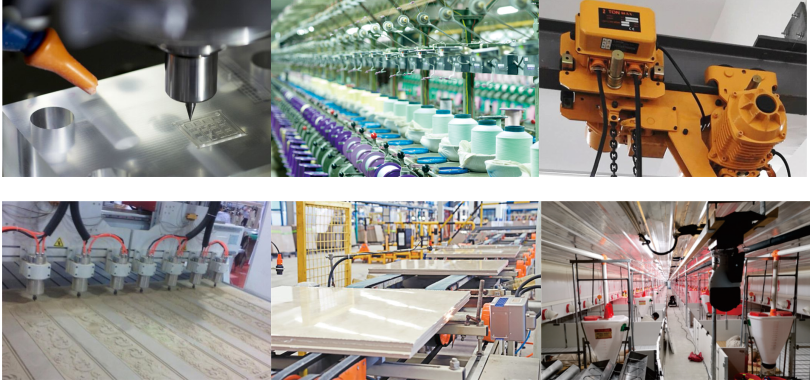
Excellent control performance
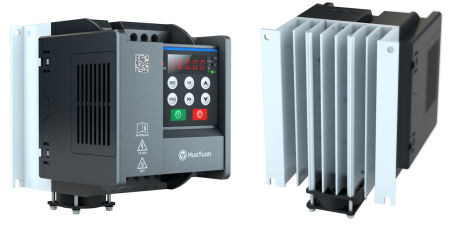
User friendly design
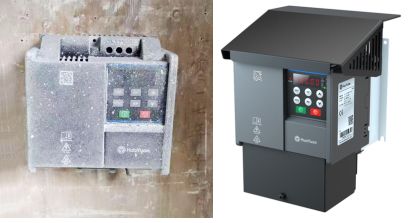
Excellent environmental tolerance performance

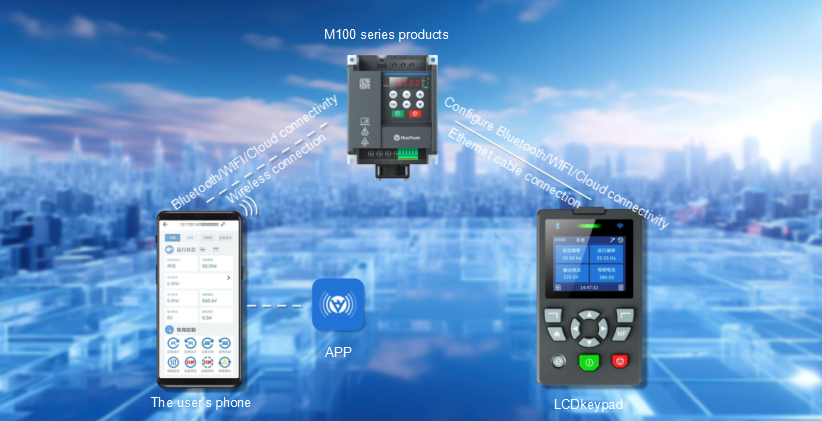
Rich expansion functions
| Item | Specifications | ||
| Input | Rated voltage, frequency | 2S: 220 ~ 240V,4T: 380 ~ 480V,50/60 Hz | |
| Allowable voltage fluctuating range | 2S:Fluctuating range 200-253V 4T:Fluctuating range 320-528V; degree of unbalance: <3% Frequency range: 47-63Hz | ||
| Output | Output voltage | 0-INPUT | |
| Output frequency | 0-320 Hz,0-3200Hz | ||
| Overload capacity | N:150% – 60 s;180% – 3 s;200% – 0.5 s | ||
| Control feature | Control mode | V/F control, SVC | |
| Starting torque | 0.25Hz 150% (SVC) | ||
| Range of speed regulation | 1:100 (V/F);1:200 (SVC) | ||
| Steady speed precision | ≤±0.5% (SVC) | ||
| Speed fluctuation | ≤±0.5% (SVC) | ||
| Torque control accuracy | SVC: ±5% (>=5.00Hz) | ||
| Torque response | ≤20ms (SVC) | ||
| Frequency precision | Low frequency operation mode | High frequency operation mode | |
| Digital setting: 0.01Hz Analog setting: maximum frequency ×0.2% | Digital setting: 0.1Hz Analog setting: maximum frequency ×0.2% | ||
| Frequency resolution | 0.01Hz | 0.1Hz | |
| Modulation system | SVPWM | ||
| Carrier frequency | 0.5 – 16kHz,modulated based on mode | ||
| Auto carrier adjustment | When the function is activated, the inverter can automatically adjust carrier frequency based on the temperature inside. | ||
| Item | Specifications | |
| Torque boost | In V/F control mode, the torque can increase by 0.1% -30% manually. | |
| Torque curve | 0: User customized V/F curve; 1: 2.0 power curve; 2: 1.7 power curve; 3: 1.2 power curve | |
| Acceleration and deceleration time | 0-6500.0s, linear or sigmoid acceleration and deceleration curve mode, optional 4 groups of acceleration and deceleration time | |
| Basic functions | Inching functions | Frequency range: 0.00-50.00 Hz |
| Acceleration and deceleration time: 0.1-60.0s | ||
| Optional interval time: 0.0-100.0s | ||
| Simple PLC, multi speeds | Up to 16 speeds can be achieved through built-in PLC function and control terminal functions | |
| Internal PID | To achieve close-loop control | |
| Wakeup | Process PID has sleep and wakeup function | |
| Torque limit | The torque is limited during speed control to prevent frequent over-current alarm | |
| DC brake | Starting frequency: 0.00- the maximum set frequency | |
| Time: 0.01 – 30.00s (0.0: not activated) | ||
| Current: 0.0-100.0% inverter rated current | ||
| Auto voltage regulation (AVR) | When input voltage deviates from the rated value, the function can be used to keep output voltage constant, so AVR is activated in general, especially when input voltage is higher than the rated value | |
| Auto current-limiting | When the input voltage deviates from the rated voltage, the function can be used to regulate the output voltage, so that AVR should be activated under normal circumstance, especially when the input voltage is higher than the rated voltage | |
| Over-voltage stalling control | Used to control the voltage of DC bus during the running of the inverter to prevent overvoltage of DC bus | |
| MODBUS communication | Standard MODBUS communication protocol for rapid communication with peripherals | |
| Item | Specifications | |
| Special functions | Binding function | Operation command channel is bound with power input channel, without parameter setting |
| Input terminal drain/source section | Through jumper terminal, drain or source can be chosen for DI1- DI5 to meet the needs in different cases | |
| Multi AI curve correction | Up to 4 points can be chosen to set AI curve for flexible and convenient curve correction | |
| Double motor parameters | Two sets of parameters of asynchronous inverters are stored to achieve the switching function between two different motors | |
| Virtual I / O port | 5 virtual DI/DO ports make complex logic control applications convenient | |
| Customer-defined parameter set | The customer can choose the required parameter set, sent to P17 as the custom parameter for daily view and modification | |
| Operation and running | Command source channel | Three modes, keyboard setting, external terminal setting, communication setting, switchable |
| Frequency source channel | Digital setting, analog setting, pulse setting, multi-speed, communication setting etc. for selection | |
| Input termina | 5 digital input terminals, DI1-DI5, drain and source input can be chosen | |
| 1 analog input terminals AI1:0 – 10V or 0-20 mA can be chosen: 1 analog input terminals AI both can be used as digital input terminal DI | ||
| Output terminal | 1 group programmable switch output, the output level is 24 V when open | |
| 1 group programmable relay output, 250 VAC/3 A 30VDC/ 3A | ||
| 1 group analog output terminals, 0-10 V or 0-20 mA can be chosen | ||
| Modle | Size | Braking unit | Rated Capacity (kVA) | Rated intput Current (A) | Rated output Current (A) | Adaptive Motor (kW) |
| M100-2S00041N-A | A | Built-in | 0.9 | 6 | 2.5 | 0.4 |
| M100-2S00071N-A | A | Built-in | 1.5 | 9.5 | 4 | 0.75 |
| M100-2S00151N-A | A | Built-in | 2.8 | 14 | 6.5 | 1.5 |
| M100-4T00071N-A | A | Built-in | 1.7 | 3.2 | 2.5 | 0.75 |
| M100-4T00151N-A | A | Built-in | 2.6 | 5.0 | 4.0 | 1.5 |
| M100-4T00221N-A | A | Built-in | 3.4 | 5.8 | 5.2 | 2.2 |
| M100-2S00221N-B | B | Built-in | 4.1 | 25 | 9 | 2.2 |
| M100-4T00401N-B | B | Built-in | 5.9 | 13 | 10 | 4.0 |
| M100-4T00551N-B | B | Built-in | 8.6 | 15 | 13 | 5.5 |
Tips: Models with * are suitable for specific occasions, please consult customer service for specific information.